

























The Infrastructure Nobody Sees
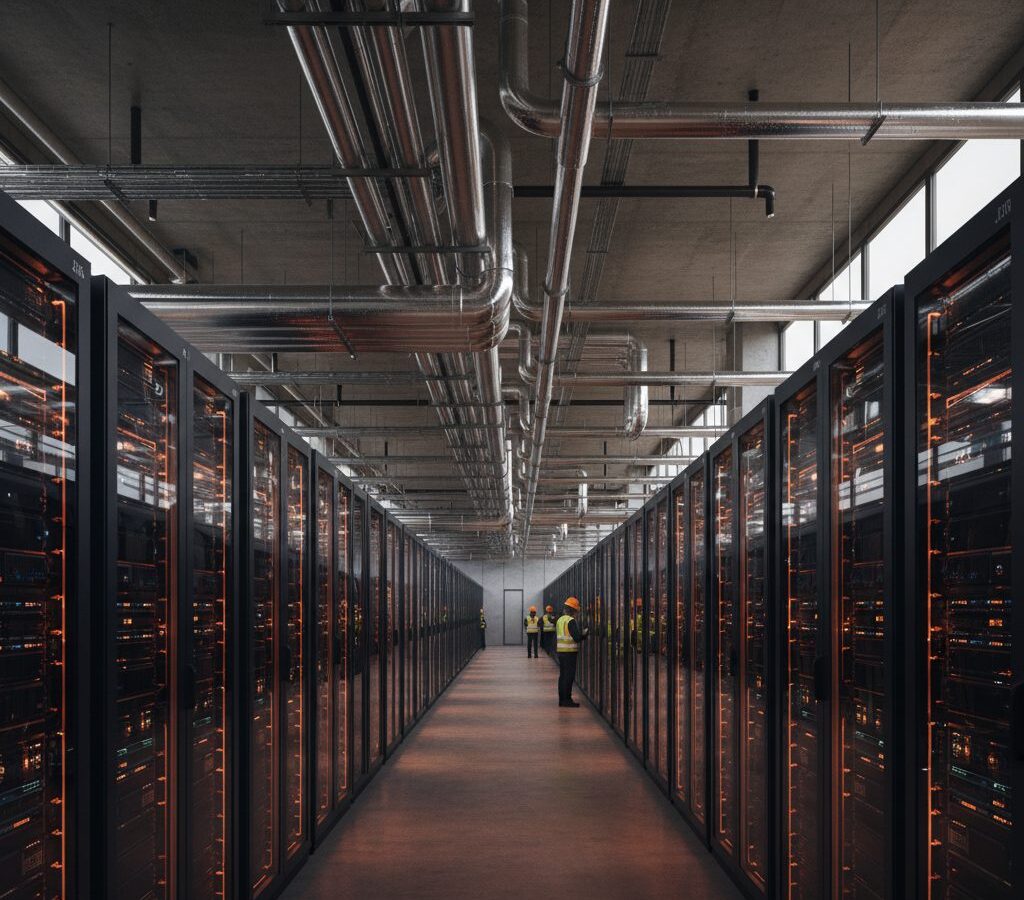
When you type a question into an AI chatbot and get a response in seconds, the experience feels almost weightless — text appearing on a screen, no moving parts, no obvious energy exchange. But somewhere, in a building you will likely never visit, a cluster of specialized chips ran hot for those few seconds, drawing power and shedding heat. Multiply that by millions of queries a day, and the numbers start to matter.
The resource footprint of artificial intelligence has become one of the more important — and underreported — stories in technology right now. It is not a reason to stop using AI tools, but it is a reason to understand what those tools actually cost, in terms that don’t appear on anyone’s invoice.
Power: More Than a Rounding Error
Data centres have consumed significant amounts of electricity for decades — streaming video, cloud storage, and financial transactions all require them. What has changed with the current wave of AI is the intensity of the workload per unit of computation.
Training a large language model — the process of exposing a system to enormous amounts of text so it can learn patterns — is especially demanding. Researchers have estimated that training a single frontier model can consume as much electricity as dozens or hundreds of transatlantic flights, depending on the model’s size and the energy mix of the data centre. These are rough comparisons, and the methodology behind them is contested, but the order of magnitude is not.
Running the model after training — what engineers call inference — is individually cheaper but happens at enormous scale. Every search query routed through an AI assistant, every image generated, every customer-service chatbot interaction draws on inference capacity. When a technology becomes ubiquitous, even modest per-query costs accumulate into something large.
The electricity source matters enormously here. A data centre running on hydroelectric or solar power carries a very different carbon cost than one running on coal or natural gas. The same computation can have a carbon footprint that varies by an order of magnitude depending on where the servers happen to be located and what the local grid looks like. This is one reason some companies have made public commitments to match their consumption with renewable energy purchases — and one reason critics argue those commitments don’t always reflect the real-time reality of what’s flowing through the power lines.
Water: The Cooling Problem
Electricity is only half the resource story. The other half is water.
Data centres generate heat — a lot of it — and that heat has to go somewhere. The two main approaches are air cooling, which uses fans and chillers that themselves require electricity, and water cooling, which circulates water through or near the hardware to absorb heat and then either reuses or evaporates that water to release the heat into the atmosphere.
Water-based cooling is often more efficient in energy terms, but it consumes a physical resource that is increasingly scarce in many regions. Estimates of how much water a data centre uses vary widely by facility design, climate, and cooling technology, but the figures cited in academic and industry research frequently run into millions of gallons per year for a single large installation.
The geography of this matters. Some of the regions that are attractive for data centre development — parts of the American Southwest and Southeast, areas of northern Europe — are also experiencing water stress from drought, population growth, or both. A data centre negotiating a permit in a water-stressed county is drawing from the same aquifer as local farms and municipal water systems.
Why It Matters
None of this is an argument against AI as a technology. The same critique, in a different form, applies to streaming video, cryptocurrency mining, and the cloud infrastructure that modern banking and healthcare run on. We have generally decided, as a society, that the benefits of networked computing justify the costs.
But the AI conversation is happening at a moment when energy grids in many countries are under pressure, when water scarcity is a genuine policy problem, and when the technology’s deployment is accelerating faster than the infrastructure to support it sustainably. Several caveats matter here:
- Efficiency is improving. Chip designers and data centre operators have strong financial incentives to reduce energy and cooling costs. The amount of computation per kilowatt-hour has improved significantly over time, and that trend continues.
- Disclosure is uneven. Some technology companies publish detailed environmental reports; others do not. Without consistent reporting standards, it is difficult to compare claims or hold companies accountable.
- Use cases vary enormously. A model helping a researcher summarize literature, a model generating hundreds of pieces of low-quality marketing copy, and a model running real-time medical diagnostics all have different resource profiles and different societal returns on that resource use.
- Local communities bear concentrated costs. The water and power demands of a data centre are felt locally — by utility ratepayers and watershed users — while the benefits are diffuse and global. This distribution mismatch is a genuine policy challenge.
What the Research Actually Shows
A useful body of work has emerged from academic researchers, independent analysts, and some data centre operators themselves. A few themes recur.
First, the energy cost of AI is real but highly variable. Studies that attempt to measure it face methodological challenges: hardware efficiency changes rapidly, energy mixes differ, and companies do not always publish the data needed for independent verification. The figures that circulate in public debate — often derived from a small number of published studies — should be treated as illustrative rather than definitive.
Second, training costs dominate the lifecycle energy budget for most models, but inference costs are growing faster as deployment scales. A model trained once but queried billions of times will, over its operational life, consume far more energy in inference than it did in training.
Third, the water intensity of AI workloads is less studied than the energy intensity, and the available data is patchier. This is partly because water is not metered and reported as consistently as electricity, and partly because cooling infrastructure varies so much between facilities.
Where the Conversation Should Go
The most productive version of this debate is not “AI is bad for the environment” versus “technology will solve everything.” It is a set of more specific questions: Which applications justify which resource costs? How should those costs be disclosed? Who bears the burden when a data centre moves into a water-stressed community? How do efficiency improvements change the calculus over time?
These are questions that engineers, regulators, and local communities are already working through, sometimes with more heat than light. The resource footprint of AI is not a reason to be alarmed, but it is a reason to be informed — and to ask better questions of the companies and policymakers who are making these decisions at scale.
For more on technology trends and their real-world implications, see our explainers section and our coverage of the internet economy.