

























The Infrastructure Nobody Sees
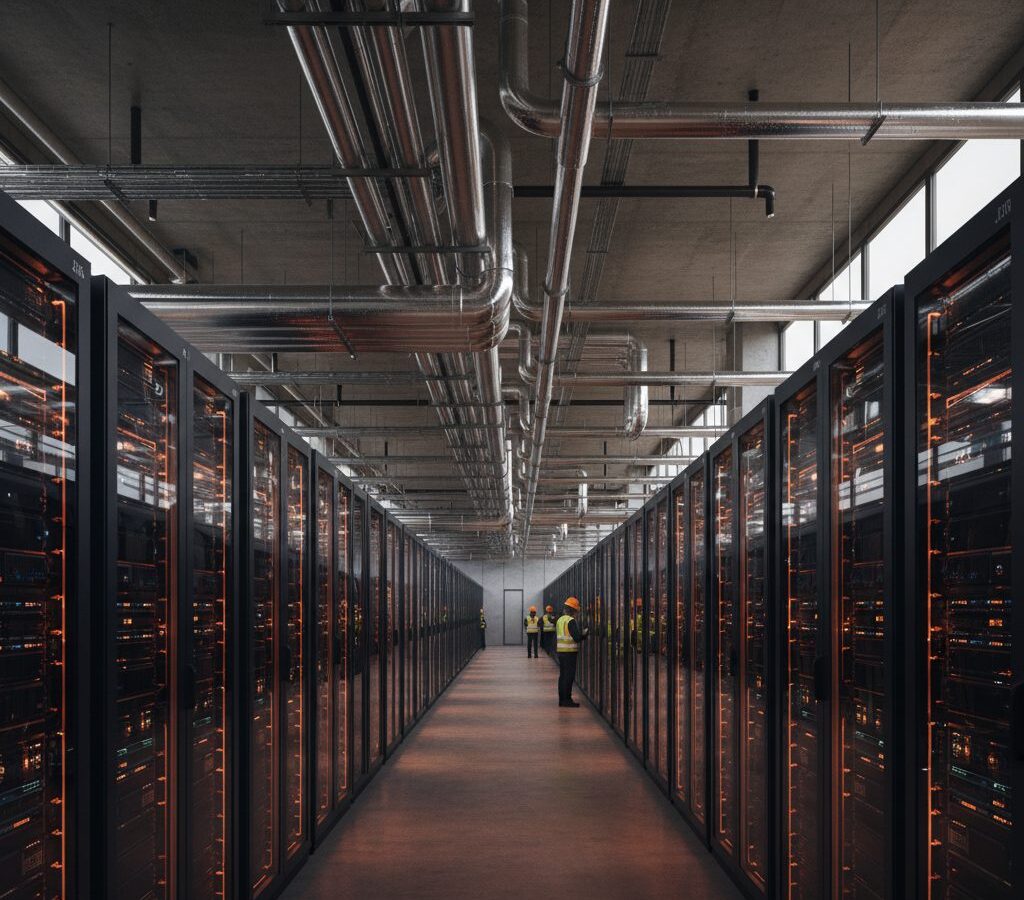
Ask an AI chatbot a question and the answer arrives in seconds. Text on a screen. No moving parts, no heat, no sense that anything physical happened at all. Something did, though. In a building you will never visit, a rack of specialized chips ran hot for those few seconds, pulling power and dumping heat into the air around it. One query is nothing. Millions a day is a different story.
The resource bill for artificial intelligence has quietly become one of the more important stories in technology — and one of the least reported. This is not a case for putting the tools down. It is a case for understanding what they actually cost, in units that show up on no invoice anyone ever sees.
Power: More Than a Rounding Error
Data centres have been electricity hogs for decades. Streaming video, cloud storage, the transaction that clears when you tap a card — all of it lives in a server hall somewhere. What the current AI wave changed is the intensity: how much computation gets crammed into each unit of work.
Training a large language model — feeding a system enormous amounts of text until it learns the patterns — is the hungriest part. Researchers have put the electricity cost of training a single frontier model somewhere in the range of dozens or hundreds of transatlantic flights, depending on how big the model is and what powers the data centre. The comparisons are crude and the methodology is genuinely contested. The order of magnitude is not.
Then there is inference, the part where the finished model answers your question. Each individual query is cheap. But inference happens constantly, at a scale that dwarfs training. Every AI-assisted search, every generated image, every chatbot handling a customer complaint draws on it. Make a technology ubiquitous and even a tiny per-query cost adds up to something enormous.
Where the electricity comes from changes everything. A data centre running on hydro or solar carries a wildly different carbon cost than one plugged into coal or natural gas. The exact same computation can vary in carbon footprint by an order of magnitude, purely on the accident of where the servers sit and what the local grid burns. That is why some companies loudly commit to matching their consumption with renewable purchases. It is also why critics say those commitments don’t always line up with what is actually flowing through the wires at any given moment.
Water: The Cooling Problem
Electricity is only half the story. The other half is water.
Data centres make heat, a lot of it, and that heat has to go somewhere. Two options dominate. Air cooling leans on fans and chillers that burn their own electricity. Water cooling circulates water through or near the hardware to soak up the heat, then either recycles it or evaporates it off into the sky.
Water cooling tends to win on energy efficiency. It also consumes a physical resource that a lot of places no longer have to spare. How much water a single facility uses swings wildly with its design, its climate, and its cooling technology, but the numbers in academic and industry research routinely reach millions of gallons a year for one large site.
Geography is the catch. Some of the most attractive spots for data centre development — stretches of the American Southwest and Southeast, parts of northern Europe — are the same places wrestling with water stress from drought, population growth, or both. A data centre applying for a permit in a water-stressed county draws from the same aquifer as the farms down the road and the pipes feeding the town.
Why It Matters
None of this is a verdict against AI. The identical critique, reshaped, lands on streaming video, on cryptocurrency mining, on the cloud infrastructure that quietly runs modern banking and healthcare. As a society we mostly decided the benefits of networked computing were worth the cost.
The timing is what makes AI different. Its deployment is accelerating at a moment when energy grids across many countries are already strained, when water scarcity is a live policy fight, and when the technology is being rolled out faster than the infrastructure meant to support it. A few things are worth holding in mind at the same time:
- Efficiency is improving. Chip designers and data centre operators have hard financial reasons to cut energy and cooling costs. Computation per kilowatt-hour has climbed sharply over time, and that trend hasn’t stopped.
- Disclosure is uneven. Some companies publish detailed environmental reports. Others publish nothing. Without common reporting standards, comparing claims or holding anyone accountable is close to impossible.
- Use cases vary enormously. A model summarizing research for a scientist, a model cranking out hundreds of pieces of throwaway marketing copy, and a model running real-time medical diagnostics carry very different resource costs — and very different returns for society on that cost.
- Local communities bear concentrated costs. A data centre’s water and power demands land locally, on utility ratepayers and watershed users. The benefits scatter globally. That mismatch is a real policy problem.
What the Research Actually Shows
A useful body of work has come out of academic researchers, independent analysts, and a handful of data centre operators. A few themes keep surfacing.
The energy cost is real, and it is all over the map. Studies trying to pin it down run into the same walls: hardware efficiency shifts fast, energy mixes differ, and companies often withhold the data needed to check the work independently. The figures that get quoted in public arguments — usually traced back to a small pile of published studies — are better read as illustrative than final.
Training dominates the lifecycle energy budget for most models today. But inference is climbing faster as deployment spreads. A model trained once and then queried billions of times will, across its working life, burn far more energy answering questions than it ever did learning to.
Water intensity is the blind spot. It is studied less than energy intensity, and the data that exists is patchier — partly because water isn’t metered and reported as tightly as electricity, and partly because cooling setups differ so much from one building to the next.
Where the Conversation Should Go
The useful version of this argument is not “AI is bad for the environment” against “technology will fix everything.” It is a set of sharper questions. Which applications earn which resource costs? How should those costs be disclosed? Who eats the burden when a data centre lands in a water-stressed community? And how do efficiency gains reshape the math as the years pass?
Engineers, regulators, and local communities are already grinding through these questions, sometimes generating more friction than clarity. The resource footprint of AI is not a reason to panic. It is a reason to get informed — and to ask harder questions of the companies and policymakers making these calls at scale.
For more on technology trends and their real-world implications, see our explainers section and our coverage of the internet economy.